
Finding a flatmate
How to find a compatible flatmate in Bangalore
The best way to find a compatible flatmate in Bangalore is to compare how you both live before you compare apartments. Discuss budget, work schedules, cleaning, food, guests, noise, pets, and move-in timing. Then meet, verify the practical details, and only shortlist homes when the everyday fit feels workable.
On this page
A good flatmate search is not about finding someone with the most impressive profile. It is about finding someone whose normal week can coexist with yours. A charming first conversation matters less than what happens when one person has an early meeting, the sink is full, a friend wants to stay over, or a shared bill is due.
Start with the person, not the property
Property-first searches create pressure. You find a promising flat, the move-in date is close, and suddenly almost any available person can seem suitable. The apartment becomes the reason to ignore unanswered questions.
A person-first search changes the order. You understand each other's routines, money limits, boundaries, and preferred areas before choosing a home together. That makes the property decision more useful because both people can judge the commute, rent, room sizes, furnishing, and neighbourhood from the same starting point.
This does not mean you need a flatmate who is exactly like you. One person can be social while the other prefers quiet. One can cook every day while the other orders food. The important question is whether those differences are understood and manageable.
Define your non-negotiables before searching
Write down what you need before speaking to potential flatmates. Separate genuine requirements from preferences.
A genuine requirement might be a firm monthly housing limit, a move-in date, permission for a pet, a smoke-free home, or access to a particular commute. A preference might be a balcony, a larger bedroom, a specific neighbourhood, or someone who shares your taste in music.
Use three groups:
- Must have: A mismatch would make the arrangement unworkable.
- Can discuss: You are open to a clear compromise.
- Nice to have: Helpful, but not worth rejecting a suitable person.
Be honest about your own habits too. If you work late, host friends often, need silence in the morning, cook meat, or expect a very tidy kitchen, say it early. Clear information is more useful than trying to sound easygoing.
Ask about an ordinary Tuesday
Weekend interests make pleasant conversation, but weekday habits usually shape the home. Ask questions that reveal what living together would actually feel like.
Money and shared costs
Agree on a realistic range for rent and recurring household costs. Discuss how you would divide utilities, internet, groceries, household supplies, repairs, and one-time purchases.
If you want a structured conversation before making a commitment, use these 31 questions to ask a flatmate before moving in. They cover the practical topics that are easy to miss when a room or move-in date creates pressure.
Ask what happens if one room is significantly larger or has an attached bathroom. Confirm when shared payments should be made and how expenses will be tracked. You do not need a complicated system, but you do need the same expectations.
Avoid stretching beyond your own limit to keep a promising match. Financial discomfort tends to return every month.
Work, sleep, and noise
Ask where and when each person works. Someone working from home may need daytime quiet and reliable internet. Someone on late shifts may need to sleep when the rest of the building is active.
Discuss alarms, calls, music, television, gaming, and quiet hours. Do not ask only whether someone is "quiet." That word means different things to different people. Ask what usually happens in their home on a workday.
Cleaning and household work
"Clean" is also too vague. Ask how often the kitchen and bathroom should be cleaned, whether dishes can stay overnight, and how shared chores should be divided.
If you expect to hire household help, discuss the cost and what work remains for the residents. A paid service does not remove the need to handle dishes, waste, spills, deliveries, and everyday clutter.
A simple written rotation can prevent one person from silently becoming the household manager.
Food, guests, pets, and boundaries
Discuss vegetarian and non-vegetarian food, cooking smells, shared utensils, allergies, groceries, and whether food is personal or communal.
For guests, ask about frequency, advance notice, overnight stays, partners, parties, and use of shared rooms. The goal is not to control each other's social lives. It is to avoid discovering incompatible boundaries after moving in.
If either person has or wants a pet, cover care, cleaning, noise, expenses, and building restrictions before choosing a home.
Compare compatibility with specifics
A useful conversation produces concrete answers. It should help you distinguish a manageable difference from a recurring conflict.
| Topic | A workable signal | Needs a deeper conversation |
|---|---|---|
| Budget | Both agree on a firm monthly range | One person expects the other to stretch |
| Cleaning | Tasks and frequency can be described | "We will figure it out later" |
| Guests | Notice and frequency expectations are clear | Boundaries are dismissed as unnecessary |
| Schedule | Sleep and work patterns can coexist | Regular noise overlaps with required quiet |
| Food | Storage and cooking expectations are understood | Allergies or strong preferences are ignored |
| Communication | Concerns can be discussed directly | Questions receive pressure, ridicule, or evasion |
Treat the table as a conversation guide, not a scorecard. One uncertain answer is not an automatic rejection. A pattern of avoiding practical questions is more important.
Check the commute like you will actually travel
In Bangalore, distance alone does not describe a commute. The same number of kilometres can feel very different depending on the route, time, transport mode, and last-mile connection.
Before committing to an area:
- Check the journey during the hours you expect to travel.
- Compare at least two realistic routes.
- Include walking, waiting, parking, and transfers.
- Consider what happens on office days, late evenings, or in rain.
- Confirm whether both flatmates can accept the trade-off.
If one person gets an easy commute while the other accepts a difficult one, discuss whether that affects the budget, room choice, or neighbourhood shortlist. Do not leave the compromise unspoken.
Meet safely and verify the basics
Begin with a call or video conversation if meeting immediately is inconvenient. When you meet in person, choose a public place and tell someone you trust where you are going.
With consent, verify the details that materially affect the arrangement. That may include identity, workplace or study information, expected move-in date, and whether the person is already responsible for a lease. Verification should be respectful and mutual.
If a property is already involved, inspect it before sending money. Understand who owns or manages it, who will receive the payment, what the payment is for, and what written record you will receive. Urgency is not proof that an opportunity is genuine.
No checklist can remove all risk, but slowing down when information is unclear is usually better than letting a deadline make the decision.
Agree on how the home will work
Before moving in, turn the important conversations into a short shared note. This is separate from any rental paperwork and should not pretend to replace it.
Record the practical decisions:
- How recurring household costs will be divided
- When payments should be made
- How chores and supplies will be handled
- Guest and overnight-stay expectations
- Quiet hours and work-from-home needs
- Food, smoking, alcohol, and pet boundaries
- How much notice to give before moving out
- How concerns should be raised
The note does not need formal language. Its purpose is shared memory. People often remember friendly conversations differently once a disagreement begins.
Review the arrangement after the first few weeks. A rule that looked sensible before moving in may need adjustment once both routines are visible.
Notice pressure and inconsistency
Pause the process if someone repeatedly changes important details, refuses reasonable verification, pushes for an immediate transfer, mocks your boundaries, or will not discuss costs clearly.
Also notice smaller signals. Do they answer direct questions? Can they disagree without becoming hostile? Do their stated habits match the examples they give? Are they curious about your needs, or only trying to fill a room?
A potential flatmate does not need to be polished or extroverted. Nervousness is normal. Look for honesty, consistency, and the ability to have a practical conversation.
Trust should develop alongside evidence. Neither a compatibility score nor a good meeting should replace basic verification.
Make the decision without chasing perfection
After each serious conversation, write down what matched, what differed, and what still needs an answer. Compare those notes with your must-have list.
A strong match usually has three qualities:
- The essential constraints work for both people.
- Differences can be discussed without pressure.
- Both people follow through on agreed next steps.
Do not reject someone only because they have different hobbies or personalities. Shared interests can make a home enjoyable, but predictable behaviour and respectful communication usually matter more.
At the same time, do not talk yourself out of a clear non-negotiable because the person seems fun. Compatibility is not the absence of differences. It is the presence of workable expectations.
Use matchpod. to start with compatibility
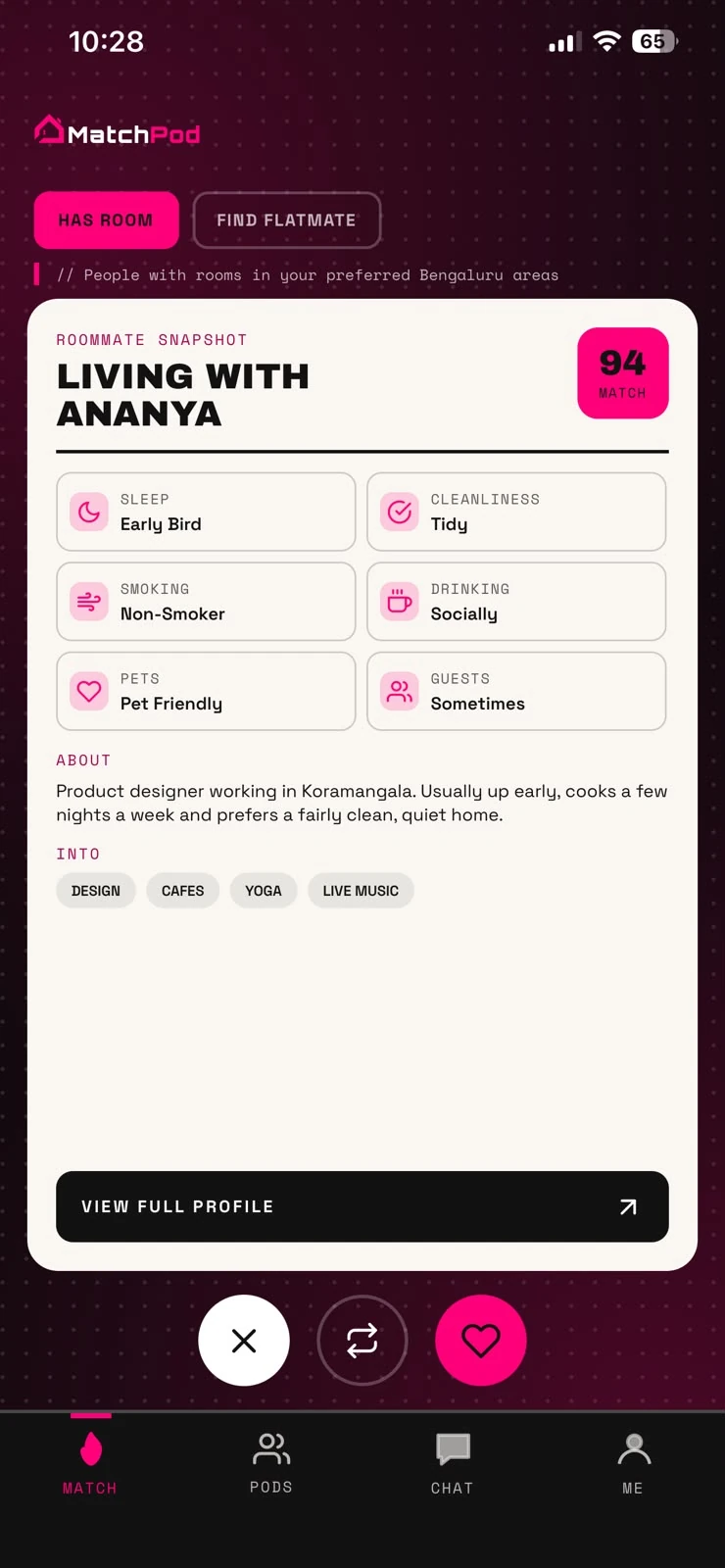
matchpod. is built around the person-first approach. People answer lifestyle questions, compare weighted compatibility, and decide whom they want to meet before searching for a home together. A mutual like creates a Pod, giving both people a clear place to continue the conversation.
The app is free and live on iPhone, with Android available on Google Play. Its compatibility score should help you ask better questions, not make the final decision for you. Meet safely, verify the practical details, and choose the arrangement that works in real life.
Finding a flatmate is a housing decision, but it is also an everyday-life decision. Start with the ordinary details. They are usually where a good shared home begins.
frequently asked questions
How do I know if a potential flatmate is compatible?
Compare the habits that affect everyday life: budget, sleep, work hours, cleaning, food, guests, noise, pets, and communication. Compatibility does not mean being identical. It means understanding the differences and agreeing on how the home will work.
What should I ask a potential flatmate first?
Start with budget, move-in timing, preferred areas, work schedule, cleanliness, food preferences, guests, and how long they expect to stay. These answers quickly reveal whether a longer conversation makes sense.
Should I find a flat or a flatmate first?
If your dates and location are flexible, finding a compatible flatmate first gives both of you a voice in choosing the home. If you already have a fixed lease, explain the home, costs, and house expectations clearly before asking someone to join.
How can I meet a potential flatmate safely?
Meet in a public place or by video first, tell someone you trust about the meeting, verify important details with consent, and do not transfer money only because a person or listing feels urgent. Inspect the home and understand who will receive any payment.
MatchPod is free on iPhone, and Android is available on Google Play. Find your person first, then the place.
keep reading
All finding a flatmate guides
31 Questions to Ask a Flatmate Before Moving In
Use these 31 practical questions to compare money, routines, guests, chores and lease expectations with a potential flatmate in Bengaluru before you move.